
The Complete Guide to Peptide Storage and Handling for Laboratory Research
Key takeaways
- Why Storage Matters
- Lyophilised Powder Storage
- Reconstituted Solution Storage
- Handling Best Practices
Why Storage Matters
Peptides are sensitive molecules. Improper storage can lead to degradation, aggregation, or loss of biological activity — all of which compromise research data. This guide covers the best practices for storing and handling research peptides from HPLC Peps, the best peptide supplier UK.
Lyophilised Powder Storage
Temperature
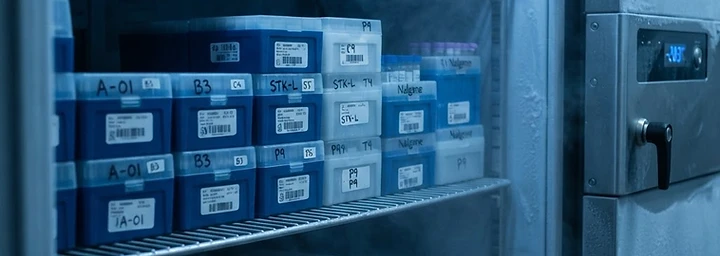
- Standard storage: -20°C (standard laboratory freezer)
- Long-term storage: -80°C (ultra-low temperature freezer) for extended storage periods
- Short-term transit: Room temperature is acceptable for brief periods (days), but minimise exposure
Light Protection
Peptides are sensitive to UV light, which can cause photo-degradation. Always:
- Store vials in their original packaging or in a dark container
- Keep vials away from direct sunlight and fluorescent lighting
- Minimise the time vials spend on the bench under laboratory lighting
Moisture Protection
Lyophilised peptides are hygroscopic — they absorb moisture from the air. Moisture uptake can cause:
- Premature degradation
- Clumping or dissolution of the powder
- Reduced stability
To protect against moisture:
- Keep vials sealed until ready for reconstitution
- Allow vials to reach room temperature before opening (to prevent condensation)
- Do not leave vials open on the bench
Reconstituted Solution Storage
Solvent Selection
Use bacteriostatic water (0.9% benzyl alcohol) for reconstitution. The benzyl alcohol preservative:
- Prevents microbial growth in the reconstituted solution
- Extends the usable life of the solution to approximately 28 days
- Does not interfere with peptide solubility or stability
Temperature
- Reconstituted solution: Store at 2–8°C (refrigerator)
- Do not freeze reconstituted solutions — freeze-thaw cycles degrade peptides
Light Protection
- Store reconstituted vials wrapped in aluminium foil or in a dark container
- Minimise exposure to laboratory lighting
Handling Best Practices
Before Opening a Vial
- Allow the vial to reach room temperature while still sealed
- Disinfect the rubber septum with an alcohol swab
- Inspect the vial for any signs of damage or contamination
During Reconstitution
- Use a clean, appropriate-gauge needle
- Inject solvent slowly against the glass wall — not directly onto the powder
- Gently swirl to dissolve — never shake vigorously
- Wait for complete dissolution before use
- Inspect for clarity — the solution should be clear without particulates
After Reconstitution
- Label the vial with: compound name, concentration, date of reconstitution, and expiry date (28 days)
- Return to refrigerated storage immediately after use
- Minimise the number of times the vial is opened
Shelf Life Guidelines
| State | Storage Condition | Approximate Shelf Life |
|---|---|---|
| Lyophilised powder | -20°C, dark | 24+ months |
| Lyophilised powder | -80°C, dark | 36+ months |
| Reconstituted (bacteriostatic water) | 2–8°C, dark | 28 days |
| Reconstituted (sterile water) | 2–8°C, dark | 24 hours |
Signs of Degradation
Watch for these indicators that a peptide may have degraded:
- Discolouration — the powder or solution changes colour unexpectedly
- Clumping — the lyophilised powder forms hard clumps (moisture uptake)
- Cloudiness — the reconstituted solution becomes cloudy or develops particulates
- Loss of solubility — the peptide no longer dissolves readily in solvent
If you observe any of these signs, contact HPLC Peps support before using the compound in your research.
Category-Specific Notes
Metabolic Research Peptides (Semaglutide, Tirzepatide, Retatrutide)
These larger peptides (31–47 amino acids) are particularly sensitive to temperature. Maintain strict -20°C storage of the lyophilised powder and use reconstituted solutions within 28 days.
Tissue Repair Peptides (BPC-157, TB-500, GHK-Cu)
BPC-157 and TB-500 are stable peptides that reconstitute readily. GHK-Cu has a characteristic blue colour when active — if the blue colour fades, the copper-peptide complex may have degraded.
Growth Hormone Secretagogues (CJC-1295, Ipamorelin, GHRP-2/6)
These peptides are generally stable but should be protected from light during storage and handling.
Conclusion
Proper storage and handling preserve the integrity of our highest purity peptides and ensure that your experimental data reflects the true properties of the compounds. By following these guidelines, you can maximise the shelf life and reliability of your HPLC Peps peptides.
For any questions about storage or handling, contact contact@hplcpeps.com.
UK Locations Mentioned in This Article
From the locations referenced above to laboratories nationwide — HPLC Peps delivers research peptides across Britain.


Related Research Compounds
Lab-verified, 99%+ purity compounds relevant to this research — each with a published Certificate of Analysis.


Bacteriostatic Water 10ml
0.9% benzyl alcohol bacteriostatic water — 10ml for laboratory reconstitution. USP grade.


Bacteriostatic Water 3ml
0.9% benzyl alcohol bacteriostatic water — 3ml for laboratory reconstitution. USP grade.


Semaglutide 30mg
GLP-1 receptor agonist — 30mg lyophilised research compound. Lab-verified, 99%+ purity.
Research-grade peptides for your laboratory
Browse the shop