
GHK-Cu UK: The Complete Guide to Copper Peptide Research
Key takeaways
- What Is GHK-Cu?
- How GHK-Cu Works in Research Models
- GHK-Cu in Regenerative Research
- The Blue Colour: Why It Matters
GHK-Cu (copper tripeptide-1) is one of the most studied regenerative peptides in UK research. For laboratories from London to Edinburgh, Manchester to Cardiff, this copper-binding tripeptide is an essential tool for investigating collagen synthesis, tissue regeneration, and extracellular matrix remodelling. This guide explains what makes GHK-Cu one of the best peptides UK for regenerative research.
What Is GHK-Cu?
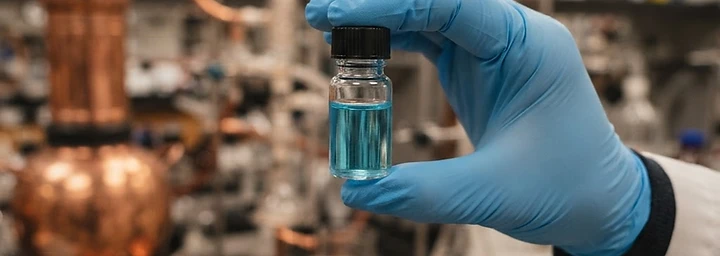
GHK-Cu is a copper-binding tripeptide composed of glycine, histidine, and lysine (GHK) complexed with a copper (II) ion. The compound has a characteristic blue colour due to the copper ion, which is a visual indicator of the active copper-peptide complex. For researchers in Cambridge, Oxford, and Bristol, this blue colour is one of the simplest ways to verify that the product contains the active form.
As one of the best reviewed peptides UK for regenerative research, GHK-Cu is supplied as a 50mg lyophilised powder with independently HPLC-verified 99%+ purity. Every batch comes with a published Certificate of Analysis showing the HPLC chromatogram and mass spectrometry data.
How GHK-Cu Works in Research Models
GHK-Cu's research value comes from the copper ion it delivers. Copper is a cofactor for lysyl oxidase, the enzyme that cross-links collagen and elastin in the extracellular matrix. Without adequate copper, lysyl oxidase activity drops and collagen fibres remain disorganised. For researchers in Leeds, Sheffield, and Nottingham, this makes GHK-Cu a key tool for collagen synthesis and tissue remodelling research.
The copper-binding tripeptide structure of GHK-Cu delivers bioavailable copper directly to cells, supporting:
- Lysyl oxidase activity and collagen cross-linking
- Fibroblast activity and extracellular matrix production
- Tissue remodelling and regeneration signalling
- Cellular repair pathway activation
For laboratories in London, Manchester, and Birmingham, GHK-Cu is often studied alongside BPC-157 (for combined collagen and angiogenesis research) and TB-500 (for combined collagen and cell migration research).
GHK-Cu in Regenerative Research
For researchers across the UK — from Edinburgh to Cardiff, Aberdeen to Plymouth — GHK-Cu is studied in a range of regenerative research applications:
Collagen synthesis research: GHK-Cu upregulates collagen production in fibroblast models, making it a standard compound for extracellular matrix studies in UK universities.
Tissue regeneration research: The copper delivery mechanism supports tissue repair processes, making GHK-Cu valuable for wound healing and regeneration pathway studies.
Cellular repair research: GHK-Cu is studied for its effects on cellular repair signalling, including fibroblast activity and matrix remodelling.
Comparative regeneration research: Many laboratories study GHK-Cu alongside BPC-157 and TB-500 to model the full tissue repair cascade — collagen synthesis (GHK-Cu), angiogenesis (BPC-157), and cell migration (TB-500).
The Blue Colour: Why It Matters
For researchers in Liverpool, Newcastle, and Belfast, the blue colour of GHK-Cu is more than just a visual characteristic — it's a quality indicator. Genuine GHK-Cu has a characteristic blue colour from the copper-peptide complex. If a supplier's product isn't blue, it may not contain the active copper-bound form.
At HPLC Peps, our GHK-Cu displays this blue colour consistently, and every batch is independently tested by a third-party laboratory with HPLC purity and mass spectrometry identity confirmation. This makes us a trusted peptide supplier UK for laboratories that need the highest purity peptides with visual and analytical verification.
GHK-Cu Blends: Glow Blend and KLOW Blend
For researchers who want GHK-Cu as part of a comprehensive regeneration reagent, HPLC Peps offers two pre-mixed blends:
Glow Blend (70mg): Combines 50mg GHK-Cu, 10mg BPC-157, and 10mg TB-500 in a single vial. This covers three principal axes of tissue repair signalling — collagen synthesis (GHK-Cu), angiogenesis (BPC-157), and cell migration (TB-500). For laboratories in Edinburgh, Glasgow, and Cardiff, Glow Blend is one of the best reviewed peptides for full-spectrum regeneration research.
KLOW Blend (80mg): Combines 50mg GHK-Cu, 10mg TB-500, 10mg BPC-157, and 10mg KPV. This adds a fourth anti-inflammatory signalling dimension, making KLOW Blend the broadest regenerative research reagent in our catalogue. For researchers in London, Manchester, and Birmingham who need the most comprehensive tissue repair and recovery research tool, KLOW Blend is the standard choice.
Both blends are supplied with independently verified 99%+ purity and published COAs, making them the best quality peptides UK for combined regeneration studies.
Buying GHK-Cu in the UK
When you buy peptides UK, there are several factors to consider:
Visual verification: The product should display the characteristic blue colour of the copper-peptide complex. If it doesn't, it may not contain the active form.
Published COA: Every batch should come with a Certificate of Analysis showing HPLC purity and mass-spec identity. The highest purity peptides always have this documentation.
Independent testing: The COA should be from an independent third-party laboratory, not from the supplier's own in-house testing.
Supplier reputation: Choose a trusted peptide supplier UK with genuine reviews from UK researchers. The best reviewed peptides UK come from suppliers with a track record of quality and transparency.
HPLC Peps meets all these criteria. We publish COAs for every batch, test independently, and supply GHK-Cu with the characteristic blue colour that confirms the active copper-peptide complex.
GHK-Cu Storage and Handling
For researchers in Aberdeen, Plymouth, and Norwich, proper storage of GHK-Cu is essential:
- Store lyophilised powder at -20°C until reconstitution
- Protect from light — the copper-peptide complex is photosensitive
- Reconstitute with bacteriostatic water, gently swirling (never shaking)
- Store the reconstituted solution at 4°C, protected from light
- Use within 10-14 days of reconstitution
Following these protocols ensures that your GHK-Cu remains at full potency throughout your study, delivering the consistent results that published research demands.
Conclusion: The Best Copper Peptide for UK Research
GHK-Cu is the standard copper peptide for regenerative research in the UK. Whether you're studying collagen synthesis in a London university, tissue regeneration in a Manchester laboratory, or the full repair cascade in an Edinburgh research facility, GHK-Cu — individually or as part of Glow Blend or KLOW Blend — is an essential tool.
For researchers across the United Kingdom — from Cardiff to Belfast, Aberdeen to Plymouth — HPLC Peps is your trusted peptide supplier UK for the highest purity copper peptides with published Certificates of Analysis. Browse our catalogue, view our lab results, and buy peptides UK with confidence.
UK Locations Mentioned in This Article
From the locations referenced above to laboratories nationwide — HPLC Peps delivers research peptides across Britain.


Related Research Compounds
Lab-verified, 99%+ purity compounds relevant to this research — each with a published Certificate of Analysis.


Bacteriostatic Water 10ml
0.9% benzyl alcohol bacteriostatic water — 10ml for laboratory reconstitution. USP grade.


Bacteriostatic Water 3ml
0.9% benzyl alcohol bacteriostatic water — 3ml for laboratory reconstitution. USP grade.


Glow Blend 70mg
50mg GHK-Cu + 10mg BPC-157 + 10mg TB-500 — 70mg blend. Lab-verified, 99%+ purity.
Research-grade peptides for your laboratory
Browse the shop