HPLC Testing and Peptide COAs: How UK Peptide Verification Works
Key takeaways
- What Is HPLC and Why Does It Matter for UK Peptide Research?
- Mass Spectrometry: Confirming Peptide Identity
- What a Certificate of Analysis Should Contain
- Why Published COAs Matter for UK Researchers
When you buy peptides UK, the single most important question is: how do you know what's in the vial? The answer lies in HPLC testing, mass spectrometry, and the Certificate of Analysis (COA) that documents the results. This guide explains how peptide testing works, what a COA tells you, and why UK researchers should never buy from a peptide supplier UK that doesn't publish their testing data.
What Is HPLC and Why Does It Matter for UK Peptide Research?
HPLC, or High-Performance Liquid Chromatography, is the gold standard for highest purity peptides testing. It separates the components of a mixture and measures how much of your sample is the target peptide versus impurities, truncated sequences, or residual solvents from synthesis.
For researchers in London, Manchester, Edinburgh, and across the UK, HPLC purity data is the difference between a reliable experiment and a wasted one. A peptide claiming 99%+ purity that's actually 85% will produce inconsistent results, confound your data, and waste your research budget.
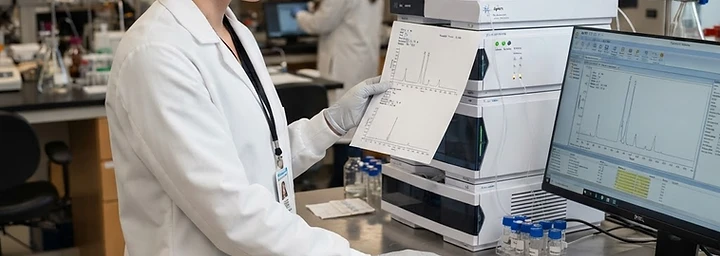
At HPLC Peps, every batch of research peptides undergoes HPLC testing before it reaches our warehouse. The chromatogram — the visual output of the HPLC test — shows a single dominant peak for the target peptide, with any impurities appearing as smaller peaks. The area under the main peak, expressed as a percentage, is the purity figure we publish on every Certificate of Analysis.
Mass Spectrometry: Confirming Peptide Identity
HPLC tells you how pure a peptide is. Mass spectrometry tells you what the peptide actually is. This is a critical distinction that many suppliers skip when you buy peptides UK.
Mass spectrometry measures the molecular weight of the peptide and compares it to the expected weight. If you order BPC-157, the mass-spec data should confirm that the molecule has the molecular weight of BPC-157 — not a truncated sequence, not a related compound, and not an entirely different peptide.
For researchers in Cambridge, Oxford, and Bristol who need to publish their findings in peer-reviewed journals, mass-spec identity confirmation is essential. Reviewers and editors increasingly ask for evidence that the compounds used in a study were what the researchers claimed they were. A COA with mass-spec data provides that evidence.
What a Certificate of Analysis Should Contain
A genuine Certificate of Analysis for research peptides should include:
- Batch number — for full traceability from synthesis to delivery
- HPLC purity percentage — the percentage of the sample that is the target peptide
- Mass-spec data — confirming the molecular weight matches the expected peptide
- Peptide content — the actual amount of peptide in the vial (vs. the total powder weight, which includes salts and water)
- Testing laboratory — the name and accreditation of the independent lab that performed the tests
- Date of testing — so you know the data is current
For researchers in Leeds, Sheffield, Nottingham, and Leicester, this level of documentation is what separates a legitimate peptide supplier UK from a reseller who buys untested powder from overseas and repackages it.
Why Published COAs Matter for UK Researchers
Many suppliers claim their products are "lab-tested" or "99% pure" — but when you ask to see the data, they can't provide it. They might say "COAs available on request" or "we test every batch" without actually publishing the results. This is a red flag.
At HPLC Peps, we publish our Certificates of Analysis on our website, linked from every product page. Researchers in Liverpool, Newcastle, Belfast, and Cardiff can view the HPLC chromatogram, the mass-spec data, and the peptide content percentage before they place an order. This is not a marketing claim — it's a laboratory document produced by an independent third-party testing facility.
For university procurement departments in Birmingham, Coventry, and Wolverhampton, published COAs are essential for compliance and audit processes. When a university buys research peptides, the procurement team needs to demonstrate that the supplier provides quality-assured compounds with full traceability. A published COA provides that documentation.
How to Read a Peptide COA
When you view a Certificate of Analysis from HPLC Peps, here's what to look for:
Purity by HPLC: This is the headline number. Our compounds consistently show 99%+ purity, representing the best reviewed peptides on the market. For researchers in Edinburgh, Glasgow, and Aberdeen running sensitive assays, this level of purity is essential for reproducible results.
Identity by Mass Spectrometry: This confirms that the molecular weight of the compound matches the expected peptide. For example, BPC-157 has a molecular weight of 1419.55 g/mol. The mass-spec data should show a peak at this mass, confirming the peptide is what it claims to be.
Peptide Content: This is the percentage of the powder in the vial that is actual peptide, versus salts and residual moisture. A vial labelled "10mg BPC-157" might contain 10mg of powder, but if the peptide content is 80%, you only have 8mg of actual BPC-157. At HPLC Peps, we ensure high peptide content so you get what you pay for.
Batch Number: Every vial from HPLC Peps has a batch number that links it to a specific COA. If you ever need to trace a batch — for a research audit, a quality investigation, or a regulatory submission — the batch number provides full traceability.
The HPLC Peps Testing Process
Every batch of research peptides at HPLC Peps follows the same testing protocol:
- Synthesis — The peptide is synthesised using solid-phase peptide synthesis (SPPS) at our UK facility
- Purification — The crude peptide is purified to remove truncated sequences and impurities
- HPLC testing — An independent laboratory tests the purified peptide for purity
- Mass-spec testing — The same lab confirms the peptide's molecular identity
- COA publication — The results are published as a Certificate of Analysis on our website
- Dispatch — The verified peptide is dispatched to researchers across the UK
This process applies to every compound we sell — from semaglutide and tirzepatide for metabolic research, to BPC-157 and TB-500 for tissue repair studies, to GHK-Cu for cellular regeneration research.
Serving UK Researchers with Verified Compounds
From university laboratories in Oxford and Cambridge to pharmaceutical research facilities in London and Manchester, from independent researchers in Leeds and Sheffield to contract research organisations in Bristol and Edinburgh — HPLC Peps serves the entire UK research community with lab-verified peptides and published COAs.
We believe that a peptide supplier UK should be transparent about what they sell. That's why we publish our testing data, why we link COAs from every product page, and why we encourage researchers to verify our claims before they buy. In a market where many suppliers hide their testing data, we put ours front and centre.
For researchers across the United Kingdom — whether you're in London, Edinburgh, Cardiff, or Belfast — HPLC Peps is your trusted source for highest purity peptides with published Certificates of Analysis. Browse our catalogue, view our lab results, and order with confidence.
UK Locations Mentioned in This Article
From the locations referenced above to laboratories nationwide — HPLC Peps delivers research peptides across Britain.


Related Research Compounds
Lab-verified, 99%+ purity compounds relevant to this research — each with a published Certificate of Analysis.


Semaglutide 30mg
GLP-1 receptor agonist — 30mg lyophilised research compound. Lab-verified, 99%+ purity.


Tirzepatide 20mg
Dual GIP/GLP-1 receptor agonist — 20mg lyophilised research compound. Lab-verified, 99%+ purity.


BPC-157 30mg
Body protection compound — 30mg synthetic peptide. Lab-verified, 99%+ purity.
Research-grade peptides for your laboratory
Browse the shop